Hero or heel? Nana's home invasion case reignites debate on Korea's self-defense laws.

[EXPLAINER]
Singer and actor Nana is no longer just a celebrity in Korea; she’s now widely seen as a hero who protected her mother from a burglar who broke into their home last year.
Her case has since emerged as a prominent example of self-defense, carrying significance in a country known for its conservative stance. So when Nana revealed she would have to face her attacker in court next Tuesday as a witness, the public was outraged: Why must a victim come face-to-face with their assailant?
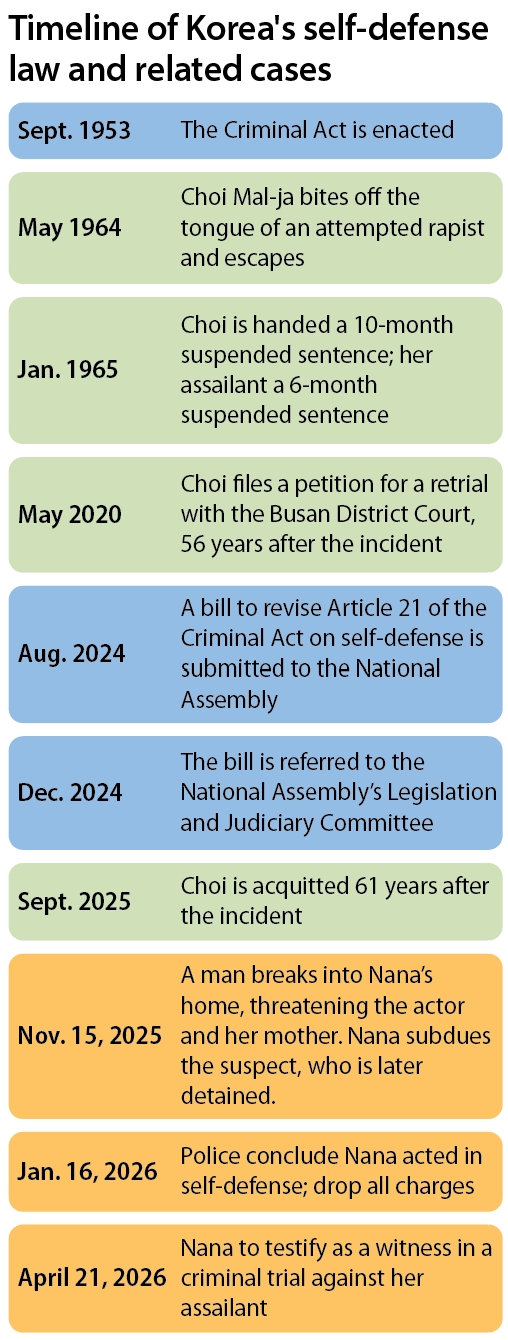
The incident dates back to the early hours of Nov. 15, 2025, when a man allegedly broke into Nana’s home in Guri, Gyeonggi, and threatened her and her mother with a weapon. Nana subdued the intruder before reporting the case to police. Nana, her mother and the suspect all reportedly suffered injuries.
The suspect has since been indicted and detained on charges of robbery resulting in injury. He also sued Nana on allegations of attempted murder and aggravated injury, but the police dropped the charges after concluding that Nana acted in self-defense.
The former member of K-pop girl group After School didn’t hide her own reluctance to take the stand, writing on social media late last month that “something is very wrong” alongside a news article confirming her upcoming court appearance. She had previously declined the subpoena, citing scheduling conflicts.
“The reality is that we have no choice but to comply with the law,” she said in the text. “I’ll be fine. I swear I’ll state only what’s true.”
Even so, the prospect of Nana facing her attacker in court left many stunned.
“The facts and [the perpetrator’s] crimes are already clear. Why does she need to testify?” one online comment with over 1,400 likes reads on a related news article. “Did the judge just want to see a celebrity?”
Q. Is it customary for the victim and the perpetrator to confront each other in court?
A. Yes, it is a standard procedure for a criminal trial.
The court does allow victims to testify without confronting the defendants, such as placing them in separate rooms, but it’s up to the court to determine whether to accept such requests from the plaintiff's side. In Nana’s case, it’s unclear whether she asked for such measures.
What does the Korean law say about self-defense?
A defensive act is qualified as self-defense and not subject to punishment as long as there are “reasonable grounds,” according to Article 21 of the Criminal Act. Key requirements also include immediacy and defensive necessity.
In simpler terms, this means that the attack must be ongoing and not in the past or future, and that the victim is in a situation where a counterattack is necessary to protect themselves. However, even at this point, precedent cases have shown that retaliation must be minimal.
This means that any “active” strike by a victim — such as after the attacker has already been subdued — may be considered excessive and therefore the claim of self-defense may not be upheld.
Article 21 of the Criminal Act also specifies that even if the defensive act is deemed excessive, the punishment can be reduced or waived if it was caused by fear, shock, excitement or confusion during extraordinary circumstances, such as at night.
“Self-defense is usually acknowledged only when it’s deemed that a person has responded appropriately to an unlawful attack,” Jang Seung-hyuk, a professor at Hanyang University’s School of Law, told the Korea JoongAng Daily. “But because the law requires that response to be proportionate, it’s often applied quite narrowly.”
A bill to amend Article 21 of the Criminal Act, seeking to expand the definition of self-defense to cover not only ongoing unlawful attacks, but also those of the “imminent future,” has been pending since August 2024.
Although the proposed amendment was referred to the National Assembly's Legislation and Judiciary Committee in December of the same year, no meaningful progress has been made as of press time.
Then why was Nana's case recognized as self-defense?
Nana was asleep at home with her mother when a stranger broke in early in the morning. Startled awake, she fought off the intruder, leaving all parties injured.
Park Sung-bae, a police officer-turned-attorney specializing in criminal and civil law, says this particular situation — Nana being inside a personal space and the attack occurring at night — is enough to be interpreted as the aforementioned extraordinary circumstances stipulated by the law, hence justifying Nana’s acts as self-defense.
“The burglar forcibly entered Nana’s house during the nighttime,” Park told the Korea JoongAng Daily. “Even if Nana’s response may have been excessive, police accepted that anyone in her situation would have reacted similarly.”
Nana’s case stands out from other situations, such as disputes on the street or inside a restaurant, as such public displays of violence are usually seen as fights because they tend to be mutual, regardless of who threw the first punch.

What are some past cases in which self-defense was either recognized or rejected?
Arguably the most infamous self-defense case in Korea involved a woman who bit off the tongue of an attempted rapist. She initially received a heavier sentence than her attacker.
Choi Mal-ja was 18 years old in 1964 when her attacker pushed her onto the ground and tried to kiss her. She was only able to escape after biting off roughly 1.5 centimeters (0.6 inches) of his tongue.
Choi was handed down a 10-month suspended sentence, while her assailant received a six-month suspended sentence. He wasn't even charged with attempted rape, as prosecutors had dropped the allegations.
The court at the time cited Choi’s defensive acts as excessive. She even had to relive her trauma by reenacting the attempted rape scene before the judge and press.
In 2020, Choi filed for a retrial and was finally acquitted on Sept. 10, 2025 — it took her 61 years to be vindicated.
Korea is notorious for being stingy in recognizing self-defense. According to a 2014 study on self-defense by Pusan National University professor Kim Byung-soo, there have only been 14 cases in which self-defense was acknowledged in court since the enactment of the Criminal Act in 1953.
In the failed cases, excessive force proved to be the main cause.
In 2012, a person was handed a 10-year prison sentence along with 10 years of wearing an electronic ankle monitor after stabbing their roommate to death with a sashimi knife.
The defendant claimed that the roommate had initiated the attack with a fruit knife, but the court ruled that their act was not self-defense because they had repeatedly stabbed the victim’s vital areas with a much larger, 41-centimeter-long weapon.
What’s next for Nana?
As Nana's case has brought renewed attention to Korea's self-defense laws in general, it is expected to reignite public discussion and possibly speed up the long-stalled bill to amend Article 21 of the Criminal Act.
“There has long been debate over whether self-defense should be recognized on a more preventive basis, especially in situations where harm is ongoing and not strictly in the present moment,” Prof. Jang said, citing a 1992 case involving a woman and her boyfriend who killed her stepfather in his sleep after years of sexual abuse.
The court found both guilty and rejected their claim of self-defense, ruling that the rape was not taking place at the exact moment of the murder.
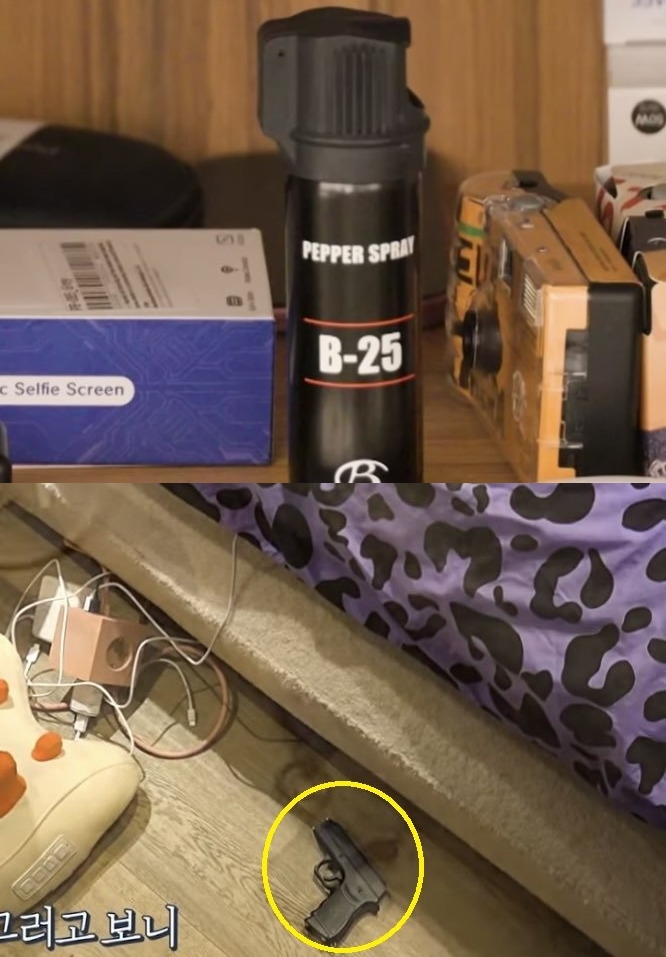
Nana has since also been open about the frightening incident on numerous variety show appearances, even sharing that she now keeps self-defense items like pepper spray around her house.
“My mother means more to me than my own life,” she said in a recent YouTube video featuring comedian Shin Dong-yeob. “I had no time to lose — I knew I had to act immediately on instinct.”
BY SHIN MIN-HEE [shin.minhee@joongang.co.kr]