Killer or savior? AI use in film 'Run to the West' poses questions on technology and the industry
AI has been generally considered a threat in the art world, and this includes the commercial film sector. But the recent release of Korea's first AI feature film "Run to the West" might play a role in upending such a trend by presenting a new possibility of AI use in cinema — an industry that's in desperate need of some sort of breakthrough to survive a prolonged slump.
Directed by Kang Yun-sung, who was behind the Disney+ series “Low Life” and film “The Outlaws” (2017), the latest AI feature film debuted on Oct. 15, mixing AI technology with human performers. It follows a chase between people trapped in a place known as the middle realm — a world between the living and the dead — and the grim reapers who seek to take their souls.
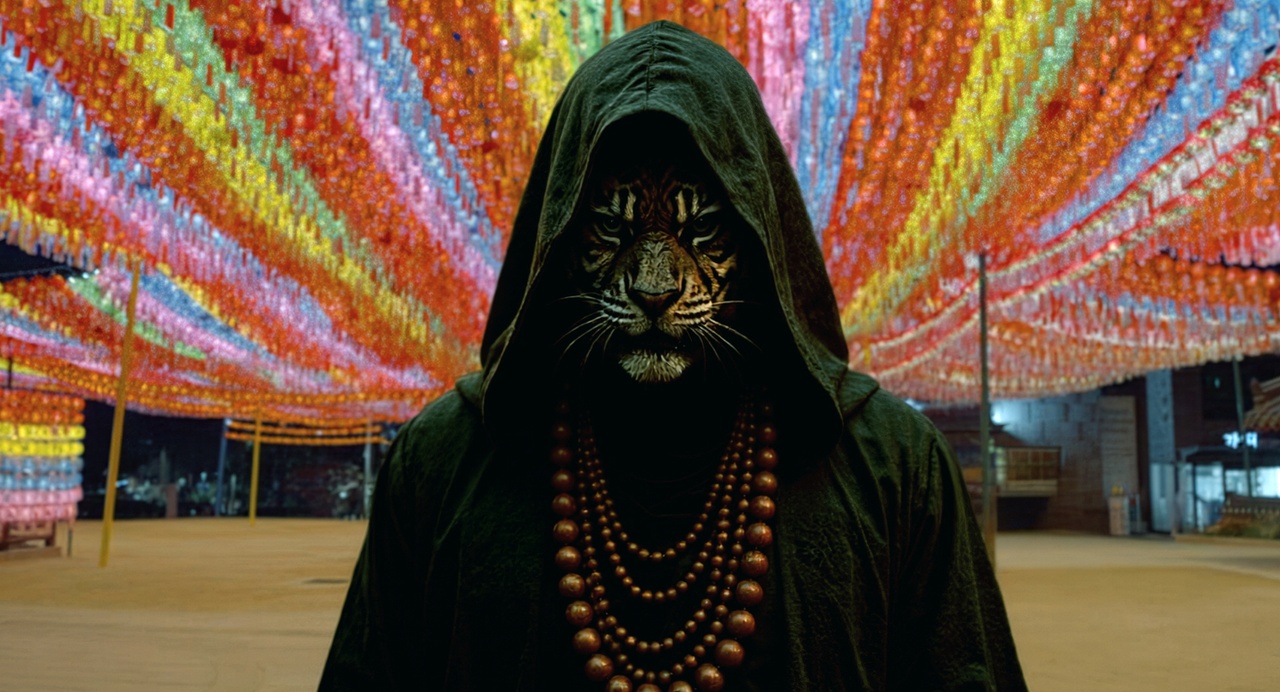
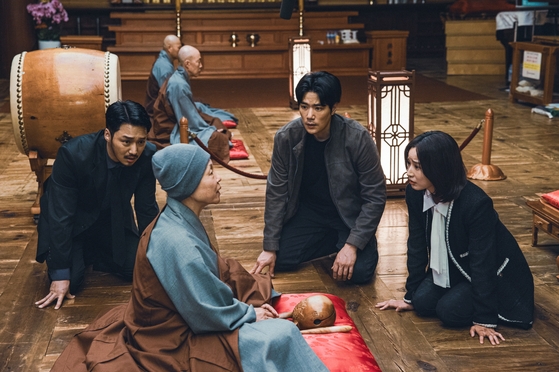
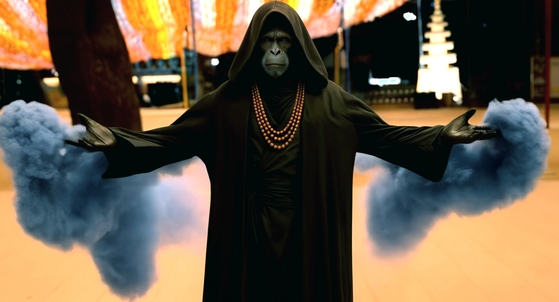
Though it features human actors, including Byun Yo-han, Kim Kang-woo, Lim Hyun-jun and Bang Hyo-rin, it extensively uses AI in place of traditional CGI and VFX work. Creature designs, action sequences and even a full-scale car explosion — tasks previously handled by human artists — were all generated using AI.
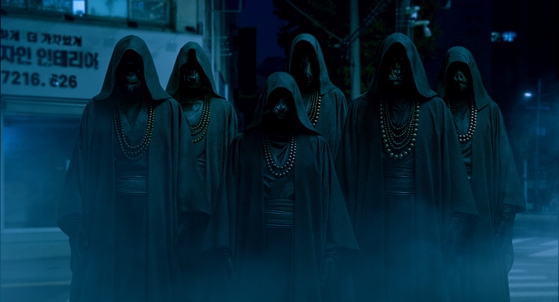
In the film, animal-faced grim reapers, representing zodiac signs, attempt to take the lives of individuals. Other AI-generated sequences include a battle between the Four Heavenly Kings against the grim reapers in a Buddhist temple and an action scene involving the god of the underworld, played by an unexpected figure.
The bold experiment quickly sparked mixed reactions after its release. Some applauded the new attempt to integrate the technology, while others criticized its quality, calling it “too soon” — a concern acknowledged by the film's director and its AI director Kwon Hansl. Kwon, who oversaw the film’s AI work, also received the Grand Prize at the inaugural AI film festival held in Dubai last year.
Despite such responses, the directors emphasized the potential benefits: AI can reduce production time and costs, which have been rising steadily, offering a possible lifeline to the struggling film industry.
So, could AI become a turning point in revitalizing Korea’s faltering film sector?
Cutting down on time and costs
After the Covid-19 pandemic hit Korea, the industry struggled, trapped in a cycle of limited investment, fewer film titles and low revenue. Overcoming this challenge has been a key goal for many insiders.
And AI technology may offer a solution by improving efficiency and lowering costs.
In “Run to the West,” a car explodes dramatically, with fire and flames bursting wildly around it. This scene incorporated AI, according to Kang, who said only the essential live-action shots, like the in-car scenes, were filmed. Kang explained that this use of AI demonstrated its efficiency, both regarding time and money — a crucial advantage in an industry often described as “a battle against time and capital.”
The AI-assisted car scene took only a few hours to produce, whereas it would normally take around four to five days to make with CGI, according to Kang. The result seemed hardly distinguishable from typical CGI and VFX-heavy productions.
As production time decreases sharply with AI, costs naturally fall due to reduced human labor — good news for creators, since rising expenses have long been a major obstacle to developing and launching new projects. While director Kang chose not to provide specific numbers, he consistently emphasized the technology's "efficiency," something that he wanted to prove through his latest film.
“What’s important is finding ways to make the workflow more efficient and reduce much of the burden of those costs, and I believe AI is one way to do that,” Kang said during an interview with reporters ahead of the film's release.
Even the postproduction period was cut to three to four months, compared with the traditional over-a-year timeline for effects-heavy productions like “Run to the West.”
Actors’ shooting days were shortened, as AI could cover many tasks without requiring separate green screen studio shoots, since it only needed on-site footage, Kang noted. This shocked the film’s cast. Actor Kim said at the film’s press conference held on Oct. 13, “I remember often asking the director, ‘Are you sure we don’t need to shoot more?’”
Other films have also shown cost reductions, such as the 2024 horror film “The Unrighteous” (2024), which used AI for 20 to 30 percent of postproduction, reportedly cutting production costs by roughly 30 percent.
Kim Ka-ni, a programmer at the Bucheon International Fantastic Film Festival in charge of the festival’s AI films, also agreed regarding AI’s cost-saving potential. This year, the festival showcased 11 AI films and announced plans to establish an AI film institute in Bucheon.
“It’s clear that using AI can save money,” Kim said. “When we don’t use AI, a lot of the cost comes from human labor. In a way, AI becomes a tool that lets creators rely less on manpower. In that sense, reducing labor costs directly means lower production costs.”
Facilitate more creativity
Lower production costs on large-scale films, including savings on shooting days and areas like CGI and VFX, give creators more freedom to be imaginative — something often restricted due to anticipated financial constraints, especially for budding filmmakers with limited budgets. Kang referred to AI as a “keyword” to shift this aspect of the industry.
“In commercial filmmaking, you can’t ignore the financial side,” Kang said. “From a director’s perspective, in such a tough environment, you end up thinking, ‘Can I really fund a 20 billion won [$14 million] or 30 billion won project?’ And that kind of thinking limits one’s imagination and constrains oneself.”
“Then the question becomes, ‘What’s the cheapest way to make this film?’ So, they end up sticking to horror films, dramas or love stories. Limiting themes and subjects like this, I think, are some of the reasons fewer people go to the theaters.”
However, there are still some current technological limitations. AI director Kwon stressed that these limitations will be overcome soon, noting that AI is developing at a speed even human programmers cannot fully imagine and that “it is just a matter of time” before they’re solved.
For example, in “Run to the West,” scenes involving creatures with movement showed some room for improvement. Kang acknowledged this, admitting that AI struggles with detail, especially in bright scenes. The creatures’ features appear slightly squashed when placed against a bright background, such as when they are positioned under the lotus lanterns at the temple, requiring some retouching with CGI.
Additionally, the generative technology reduces limitations due to a lack of resources, allowing the imagination to stretch even further, which Kang foresees. He hopes to see more genres not often dealt with in Korea, like space stories.
“There were some genres that were difficult to produce in Korea, like space stories,” Kang said. “These specialized genres were really hard to tackle because creating these kinds of stories usually requires a lot of accumulated know-how among the production team. But with AI, even when that foundation isn’t very strong, creators can still pull out a certain level of results.”
“So, I believe AI could allow us to create far more of the kind of humor and stories that only Koreans can come up with.”
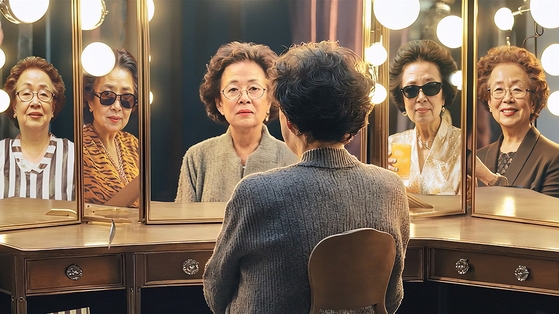
AI also broadens the opportunities for recreating human actors at a lower cost. In the film “It’s Me, Moon-hee” (2024), a compilation of five short films, the real actor Na Moon-hee appears in various roles, including as an astronaut and a gang member. However, the actor did not actually perform in the movie. The actor described the experience as “like having wings through AI, even if my body isn’t free.”
AI studio MCA CEO Park Jae-soo, who was behind the film “It’s Me, Moon-hee,” told Sports Seoul, “AI films featuring well-known actors can be made with just a 10th of the usual budget. The advancement of technology won’t take away human jobs; it will benefit the world.”
“Mad Max” (1979) director George Miller echoed a similar sentiment, calling AI a game-changer due to its accessibility in an interview with The Guardian.
“It will make screen storytelling available to anyone who has a calling to it,” he said. “I know kids not yet in their teens using AI. They don’t have to raise money. They’re making films — or at least putting footage together. It’s way more egalitarian.”
Meanwhile, the film ignited debate over replacing human performers with AI actors. Yet, experts say technological limits and skepticism toward AI mean it will be a long time before such actors appear in Korean films — if ever.
“AI might be able to mimic gestures or actions, but even when reading the same lines, the delivery is different each time when done by humans,” Kang said. ”It’s about choosing a specific emotion and editing all those takes together to create a coherent whole. That’s why AI actors can’t really replace humans, and similarly, it’s hard to replace the director who makes those creative choices.”
BY KIM JI-YE [kim.jiye@joongang.co.kr]