What is techno music? For these DJs, a religion and an art.
It was meant to be a carefree Saturday night, but I found myself staring at my phone in the middle of a crowd packed inside Sejong Center’s underground Sejong S Theater in central Seoul, caught up in an untimely work discussion that was going nowhere.
Then the DJ dropped a pulse of beats into a slowly but surely building techno set, and suddenly the sight of people swaying from side to side, eyes either closed or fixed on the booth, felt almost surreal. As if drawn into some collective trance, in that instant, the thought came: You know what? Forget it. Whatever.
Such moments are, in a way, the essence of techno — an escape from reality that pulls the dance floor into a raw, instinctive headspace, stripping away self-consciousness. The Sejong Center described it as a state suspended somewhere between focus and release. And that experience has an element akin to an instinctive ancient ritual, wherein one's sole focus is the present moment.
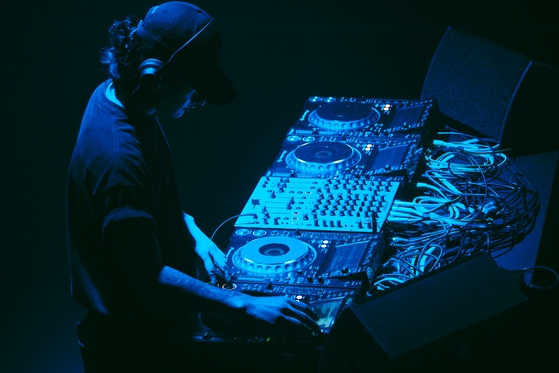
The five-hour performance, which took place on Friday and Saturday, closed out Sync Next 25, the annual contemporary and experimental performance series that is now in its fourth edition. For the latest show, the center invited techno collective vurt. to curate the music and eobchae, an audiovisual artist group, to shape the thematic and visual concept.
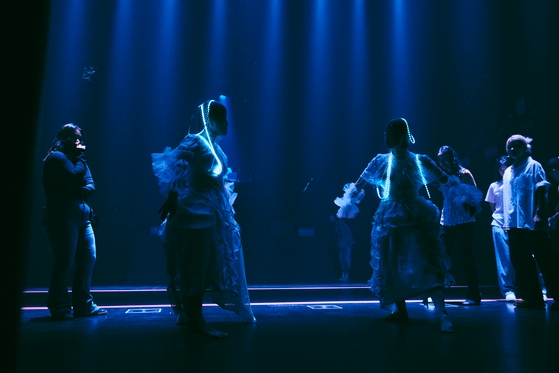
Saturday's lineup included DJs Inger, Scøpe, Anthony Linell and Djilogue, interspersed with live performance art and a burlesque show that drew inspiration from Korea's traditional practice of shamanism. On Friday, DJs Rrose, Xanexx. Siot and Suna took to the booth.
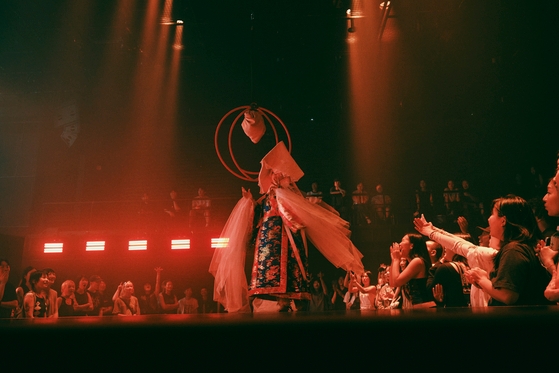
For a newcomer to underground techno, the fusion of sound and performance art felt almost spiritual, or even religious — especially when burlesque performer Bulzamzi walked onstage in outfits inspired by traditional shaman’s robes, only to peel them away one by one, kiss audience members at random and ultimately launch herself skyward on an aerial hoop, amplifying the surreal atmosphere.
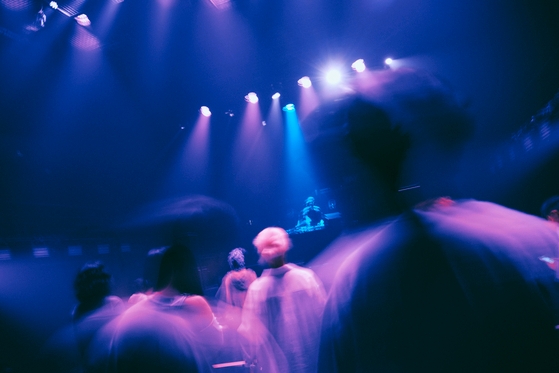
Unlike popish sets with explosive choruses and melodic highlights that one might expect to see at clubs, each DJ worked within one-hour slots, building up their sets with minimum melodic or emotive progression. The result was less about climax than about immersion, the slow absorption into the rhythm that blurred the boundaries between what was real and what was not.
That trance was central to the night’s theme, as the show was built around eobchae’s “Idempotentia” project, which draws inspiration from the concept of idempotency — when repeating an operation creates the same effect as doing it once would — and reframes it as a religion for modern times. Berlin’ Unesco-recognized techno culture served as initial inspiration, but eobchae interpreted it through a distinctively Korean, ritual-inspired lens.
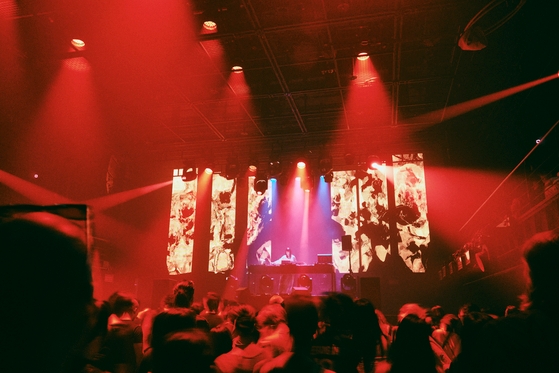
The show’s slogan — “Techno is not a sound. It’s a state.” — reflected that idea and also echoed vurt.’s longstanding motto of “ancient future.”
Djilogue, who co-founded vurt. back in 2014 and spearheaded the curation, explained that techno is a modern echo of one of humanity’s oldest instincts: to dance as a spiritual act.
“The goal is to let the audience experience immersion itself and to imagine what change could be sparked when we focus wholly on the present moment,” Djilogue said during an interview with the Korea JoongAng Daily ahead of the show.
For Sync Next, which experiments with various genres in a bid to present new cultural opportunities under its slogan, “This is the new black,” its final performance has proven to be a bold but successful experiment, according to Sejong Center’s Cobb Cho, who spearheaded the project.
“I was initially a bit worried about how audiences would react to presenting an underground genre on a public theater stage,” Cho said. “But I could see them fully immersed in the experience, letting go of self consciousness and just living in the moment.”
Sync Next is a production series that has grown alongside Sejong Center’s 2022 declaration to become a producing theater. This year’s edition featured 11 programs and 32 shows featuring performers including comedian Moon Sang-hoon and musician Lucid Fall.
As the series builds its brand identity, Cho noted that some fans now follow all of Sync Next's performances, something he takes particular pride in.
Looking ahead to next year, which will mark the fifth anniversary of the Sync Next brand, Cho hopes the series will stay true to and expand on its mission of pushing the boundaries of what a public theater can do.
“Even on the global standard, it’s extremely rare for a public theater to take such a leading role in producing contemporary performances and works,” Cho noted. “As it will be our fifth anniversary, I think it’ll be the right time to reflect on what we’ve created so far and what we’ve introduced to audiences.”
BY SHIN HA-NEE [shin.hanee@joongang.co.kr]